
Collaborative Robots in Welding: Advantages and Practical Application Cases
Collaborative Robots Empower New Development in Welding Industry
Collaborative robots (cobots), with their high safety, flexible deployment, and ease of operation, are rapidly gaining popularity in the welding field. Compared to traditional industrial robots, cobots are better suited for small-batch, multi-variety production needs of small and medium enterprises.
Core Advantages
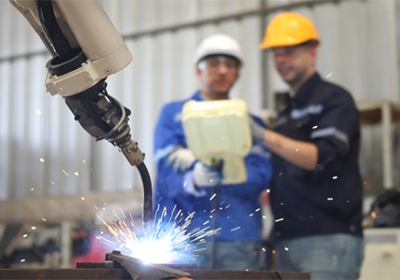
Safe Collaboration: Built-in torque sensors and collision detection enable safe operation in the same workspace as workers
Rapid Deployment: No safety fences required, short installation cycle, simple debugging
Easy Programming: Drag-and-teach and graphical programming lower operational barriers
Flexible Adaptation: Easy workstation switching to accommodate multi-variety small-batch production
Controllable Costs: Shorter ROI cycle compared to traditional robot solutions
Typical Application Scenarios
Collaborative welding robots are widely used in:
Precision Parts Welding: Welding processing of precision components in 3C electronics and medical devices
Small Batch Multi-Variety: Flexible production of customized metal products
Touch-up Stations: Supplementary welding of complex welds with large welding equipment
Prefabricated Components: Standardized welding production of steel structures and building components
Implementation Recommendations
When introducing collaborative welding robots, enterprises should focus on equipment compatibility with existing processes, peripheral equipment integration, and operator training investment. Through systematic planning and implementation, the advantages of collaborative robots can be fully leveraged.